LinkedIn has a lot of opinions about what AI is doing to design. I wanted to hear from the people running design teams right now.
In October I spoke with 6 design leaders in banking, financial services, fintech and retail. Their teams range from 8 designers to about 65. Each conversation was 30 minutes, built around the same 9 questions on team structure, AI use, ways of working and hiring. Leaders are anonymous unless they agreed to be named.
Six conversations can show a pattern, but they don't prove how common it is. So I share how many leaders said something, not percentages. They can be used as early signals.
This is the first edition. Each month I'll add new conversations, the picture will change as it grows.
The short version
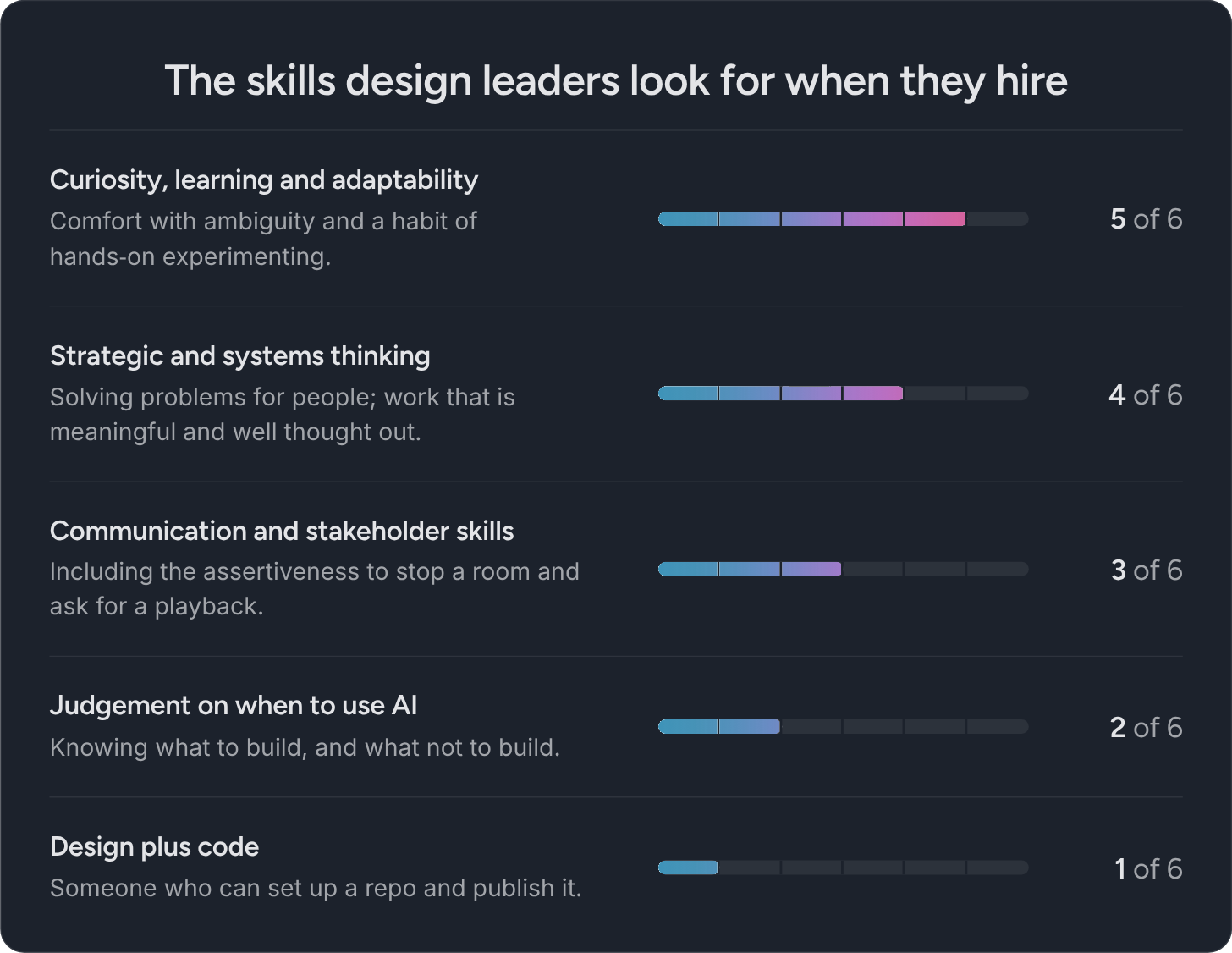
- Curiosity is the top mindset leaders hire for. Curiosity, learning and adaptability came up more than any other skill. Half of the leaders said AI caused them to double down on what they already looked for.
- No one has a standard AI fluency test. Some leaders have added a hands-on test or questions about AI to their interviews. Others haven't changed their process.
- Design, product and engineering are overlapping. Product managers are making prototypes, and designers are starting to work in code.
- Leaders use AI to plan and manage. Designers use it to make things. Leaders are focused on setting how their teams use AI. Their teams are using it to prototype and to turn designs into code.
- Headcount is flat, capped or uncertain on all but one team. That team is planning to double.
- Visual and UX titles are folding into product designer. Product designer is now the main title on many teams, and one team has added a new role, the design engineer.
- Tomorrow's strong designer frames the problem. Leaders described three kinds of strong designers, a thinker, a connector who brings people together and a builder.
What I learned
1. AI raised the value of human skills
When I asked what has changed in hiring, half the leaders said AI caused them to double down on what they already looked for. Five named curiosity, learning or adaptability. Four named strategic and systems thinking. Three named communication and stakeholder skills.
One leader described what they look for now.
"Anything basic AI can do is no longer what I'm looking for. I'm looking for critical thinkers who are curious and can ask damn good questions."
Hiring for code is still rare. One leader has looked for strong design and coding skills in recent searches.
2. No one has a standard AI fluency test
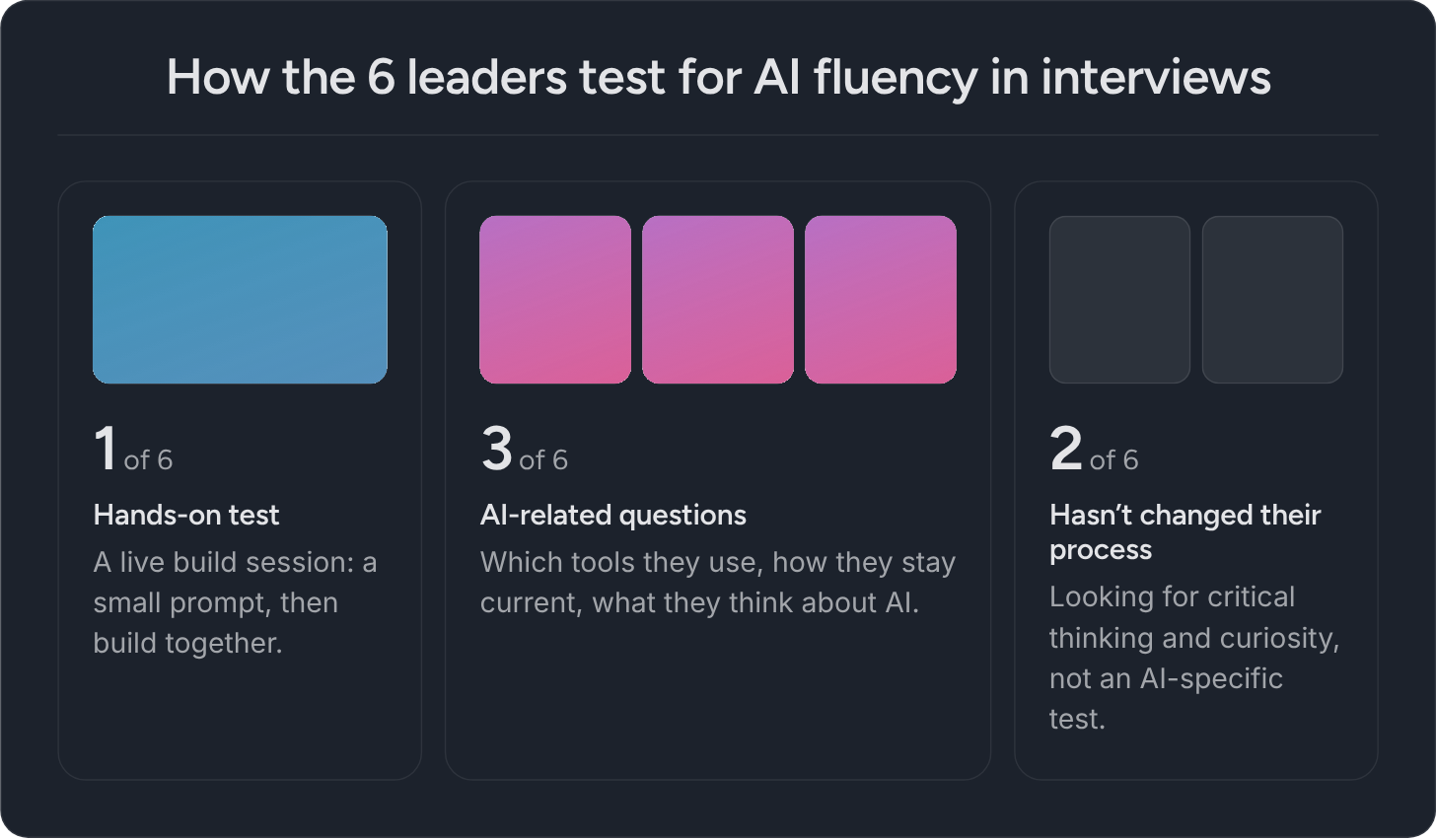
None of the 6 leaders has a consistent way to test for AI fluency.
- One team runs a hands-on test, a live build session with a small prompt. Even there, each director runs it differently, and the team is working to standardize it.
- Three leaders ask about AI in the interview. Which tools you use, how you stay current, what you think about AI.
- Two haven't changed their process. They look for critical thinking and curiosity instead.
One leader raised a fairness problem. Designers at financial institutions often work behind firewalls, so they can't show AI fluency through their day job. That leader looks at what candidates are learning outside of work.
3. Design, product and engineering are overlapping
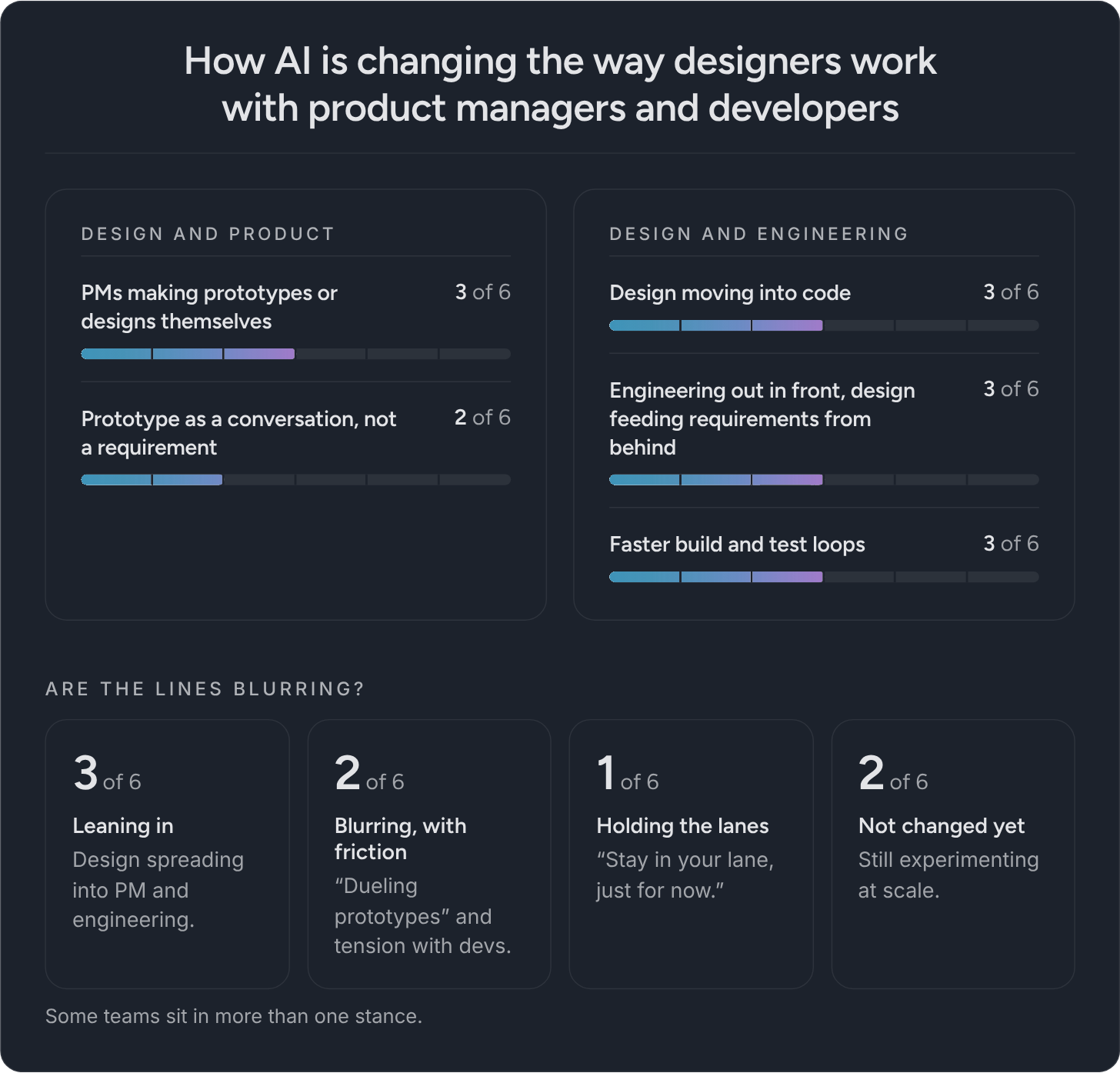
Product managers are moving into design work. On half the teams, PMs now make prototypes or designs themselves. On one team, some PMs bring a prototype instead of a requirements doc. When it works, the prototype starts a conversation. When it doesn't, one leader described "dueling prototypes" between design and product.
Design is moving into engineering work. On half the teams, designers are starting to work in code. On one team, designers open a pull request and engineers review it, and the leader says the front-end developer role is coming into question. Engineering is still ahead. On another team, engineering has worked with AI for 9 months and design for 3 weeks, and the leader described engineers as "way out in front of us."
"Roles are becoming horizontal, with design reaching into both product and engineering."
The overlap looks different on every team. Three are leaning into it. Two described friction. One leader is holding the lanes for now. Two said the way they work hasn't changed yet. Some teams sit in more than one place.
4. Leaders use AI to plan and manage. Designers use it to make things.
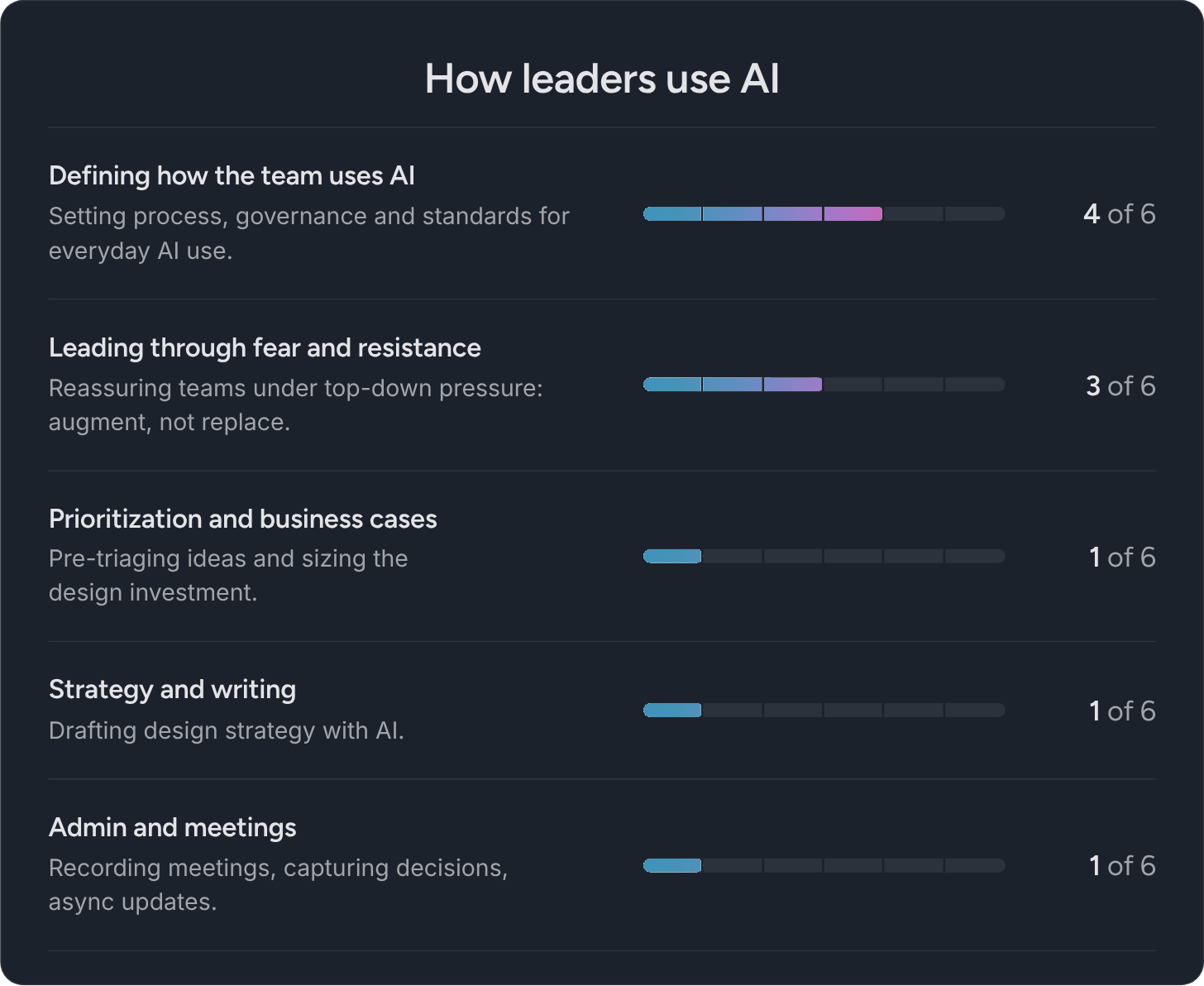
Leaders described their own AI use as work around design. Four are defining how their team should use AI. Three are leading teams through fear and resistance. Individual leaders use it to triage ideas, size business cases, draft strategy and cut down admin.
Teams use it to make things. Four teams use AI for prototyping, four for design-to-code, and four use or plan to use it in research.
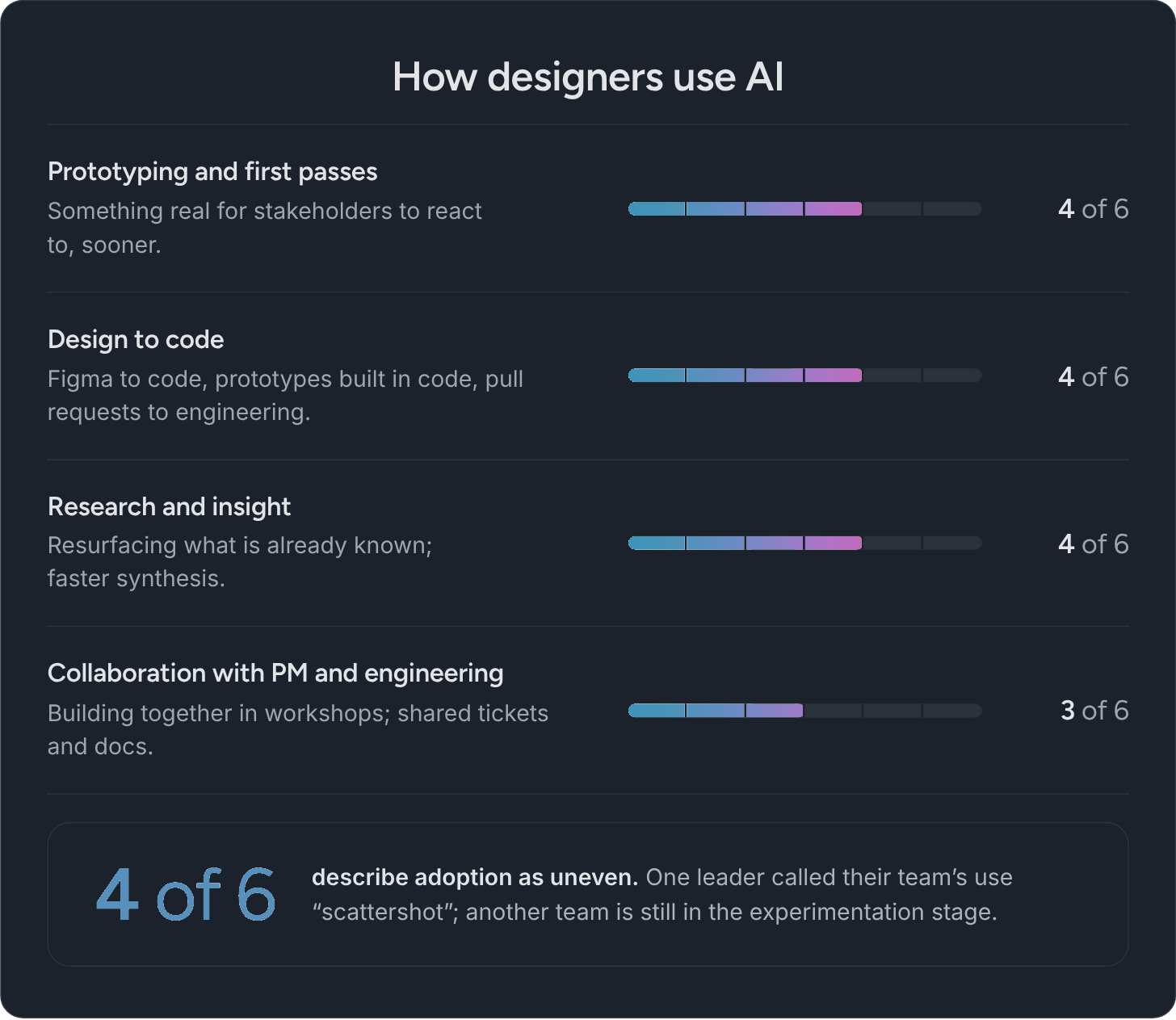
Every team is at a different stage. Four leaders described their team's use as still taking shape, with people trying tools and working out what fits.
5. Headcount is flat, and AI is part of why
All but one team described headcount as flat, capped or uncertain. The range is wide. One team was cut in half, while another is planning to double.
"We don't hire at the scale we would have if AI wasn't around."
On another team, the one director asking for more headcount is the one using less AI. When teams do hire, they describe hybrids and generalists. A product designer over a specialist, or someone who can run discovery and use AI tools on their own.
6. Visual and UX titles are folding into product designer
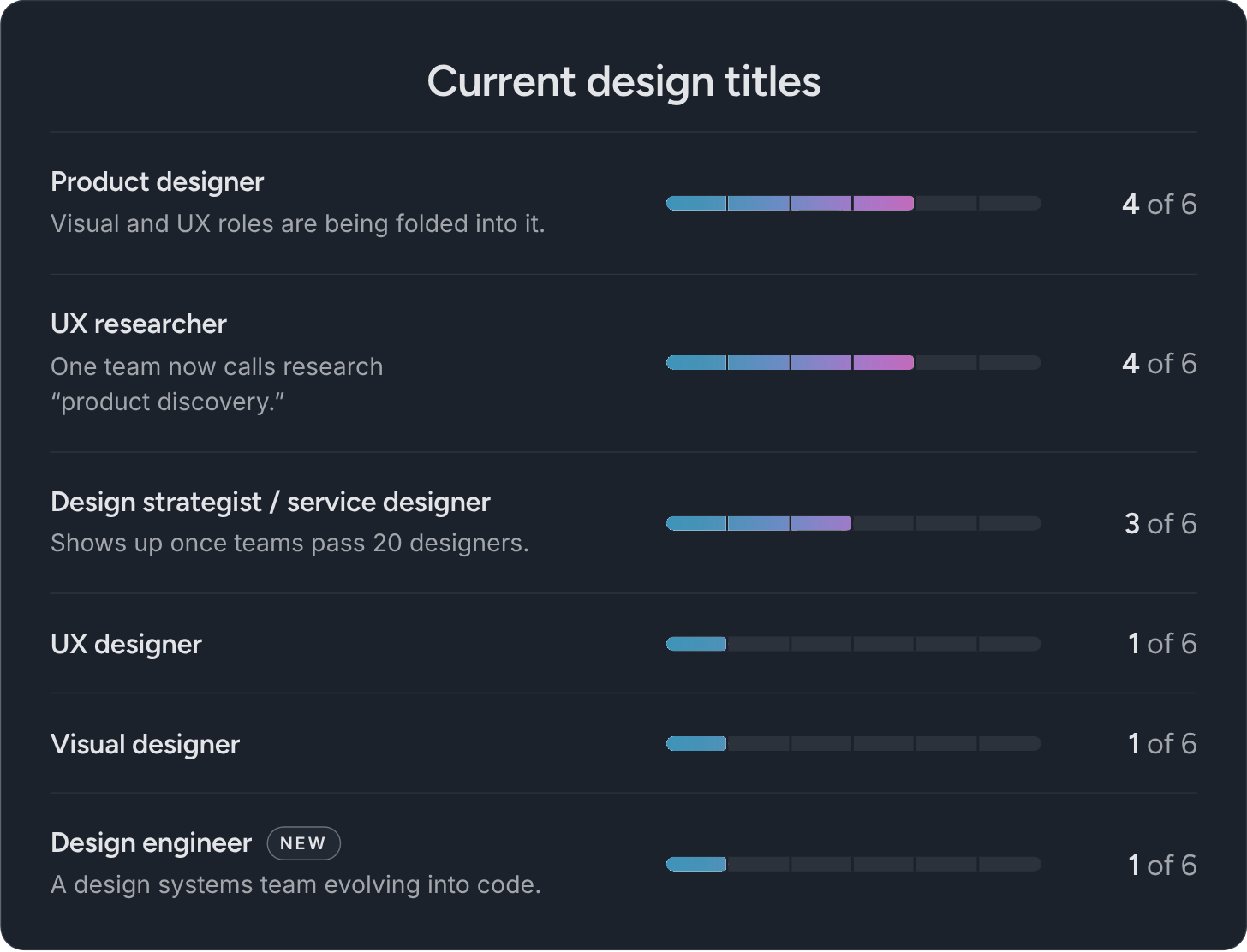
Four teams use product designer as their main title. One converted its visual and UX designers into product designers.
Other roles are holding. Four teams have UX researchers, and three have design strategists or service designers. One has added a new role, the design engineer. That team's design systems group is evolving into it. Design engineers use AI tools to turn Figma designs into code, then work with the development team to get it into the product.
7. Tomorrow's strong designer frames the problem
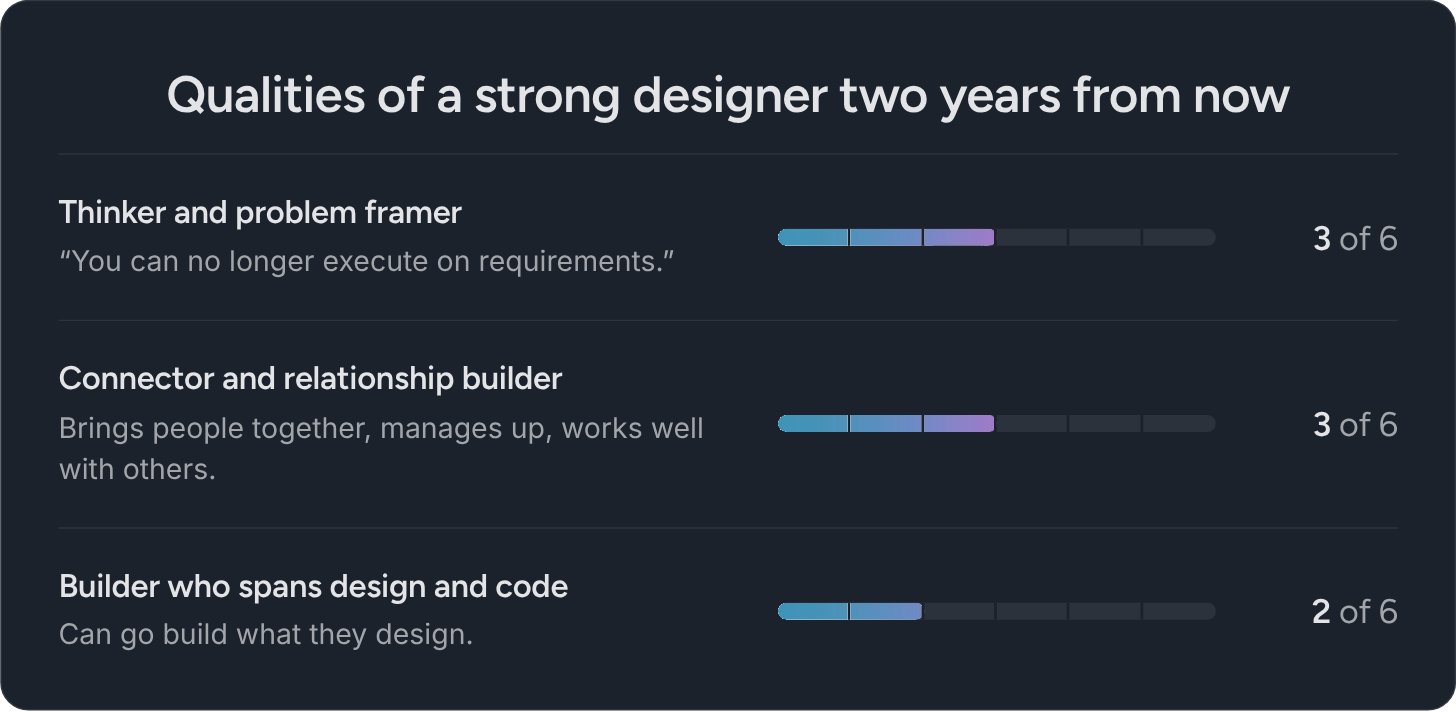
Asked what a strong designer looks like in two years, three leaders described a thinker who frames the problem, and three a connector who brings people together. Two described a builder who can build what they design. Some leaders described more than one.
"You can no longer execute on requirements. AI will do that faster."
One leader named the skill AI is missing. It will produce screens on request, but it won't ask, "What if we just didn't do this?"
Three questions to add to your next design interview
These build on what the leaders in this study are trying in interviews, and what they look for in designers.
1. Walk me through a recent project where you used AI. What did you use it for and what did you not use it for?
- Listen for specific tools tied to specific steps, and a clear moment where they chose their own judgement over the output.
- Watch for "I use AI for everything" or "I don't really use it." Both suggest they haven't worked out where it fits.
2. Here's a short problem. Work through it with any AI tool you like, and talk me through your thinking as you go.
- Listen for how they frame the problem before they prompt. Strong candidates ask questions, give the tool enough context, and push back on what comes back.
- Watch for a jump straight to screens, or a first answer taken as the final one.
3. How has your design process changed in the last year?
- Listen for concrete changes, such as how they collaborate with PMs and developers, new tools they're using, or spending more time on research because production is faster.
- Watch for a process that sounds the same as three years ago.
What's next
Six conversations in, AI is changing the tools, and design leaders are putting more weight on the human skills behind good design.
Next month I'm speaking with six more design leaders. I'll share what they're seeing in the next edition.
If you lead a design team and want to contribute, reach out and say hi. It's a 30-minute conversation, and you can stay anonymous.
Get the next edition by email
Monthly, I'll share what I learn from leaders on how our industry is evolving.
Free on Substack. Unsubscribe anytime.